

Definitions#
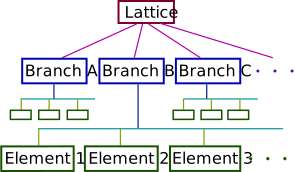
Fig. 2 An expanded lattice contains a set of branches (not necessarily in an array) and each branch holds an ordered array of lattice elements.#
Branch: Contains an ordered list of lattice elements that can be tracked through. A branch can describe such things as a storage ring or Linac.Branch expansion: The process, starting from therootBeamLineof a branch, of constructing the ordered list of lattice elements contained in that branch.Element: SeeLattice element.Lattice: The outermost structure that holds a set of branches and can be used to define an entire accelerator complex.Lattice expansion: This includesbranch expansionalong with connecting branches together viaForkelements, expression evaluations, and floor position and reference species and energy calculation.Root BeamLine: ABeamLinethat is used as the basis for creating a branch.Root branch: A branch that is specified in aLatticestructure. Non-root branches are branches that are formed due to the presence ofForkelements.Lattice element: Basic building block of a lattice most often representing something physical like a quadrupole magnet or an RF cavity.
Lattice Elements#
The basic building block used to describe an accelerator is the lattice element. Typically, a lattice element is something physical like a bending magnet or an electrostatic quadrupole, or a diffracting crystal. Further details here.
Lattice Branches#
A lattice branch holds an ordered array of lattice elements
that gives the sequence of elements to be tracked through.
A branch can represent something like a storage ring, transfer line or Linac.
In the simplest case, a program can track through the elements one element at a time.
However, lattice elements may overlap which will naturally complicate tracking.
Lattices#
A lattice is the root structure holding the information about a
machine. A machine may be as simple as a line of elements (like the elements of a Linac) or
as complicated as an entire accelerator complex with multiple storage rings, Linacs, transfer
lines, etc.
Essentially a lattice has an array of branches with each branch describing part of the
machine. Branches can be interconnected to form a unified whole.
Branches can be interconnected using Fork elements.
This is used to simulate forking beamlines such as a connections to a transfer line, dump line, or an
X-ray beamline.
Besides branches, a lattice will hold information like details of any support girders that are
present and multipass information in the case where elements are transversed multiple times
as in an ERL or in opposite directions as in a colliding beam machine.
Root branch#
The branch from which other branches fork but is not forked to by any
other branch is called a root branch.
A lattice may contain multiple root branches. For example, a pair of intersecting storage
rings will generally have two root branches, one for each ring.
Lattice Expansion#
An important concept is lattice expansion and branch expansion.
Branch expansion is the process, starting from the root BeamLine
of a branch, of constructing the ordered list of lattice elements contained in that branch.
Lattice expansion involves branch expansion along with things like
calculating the reference energy for all elements. The result is a Expanded Lattice.
Expanded Lattice#
The “expanded lattice” is the lattice that is the result of lattice expansion. This lattice is a structure with all branches expanded and all computable parameters computed. These computable parameters include:
Element reference energy and reference species.
Element longitudinal s-position.
Element floor coordinates both nominal and with alignment shifts.
Element dependent parameters (for example,
L_sagittafor a bend).
Enum#
An enum parameter (often called an “enumerated type”) is one whose value must be one of a set of named values.
For example, the cavity_type parameter of
the RFP parameter group has valid values STANDING_WAVE and TRAVELING_WAVE.
The advantage of designating a parameter as an enum is that the parameter value can be validated.
Extensions#
An Extension is data added to a PALS file that is not part of the PALS standard. For example, information specific to a particular machine or simulation program that has no analogue with other machines can be put in as an extension. A list of documented extensions is in the Extension section.
PALS Compliant Parser#
A PALS compliant parser is a parser that can read in PALS file(ss) (plural if there contained or included files) and can construct an “appropriate” information tree (or trees) in memory. To be compliant, the constructed information tree must contain the information to construct the original PALS files. The information tree must also contain the expanded lattice.