Overview#
The Particle Accelerator Language Standard (PALS) defines a standard for the sharing of machine information in general and lattice information in particular for particle accelerators and storage rings. PALS aims to promote:
Portability between various applications and differing algorithms
A unified open access description for scientific data (publishing and archiving)
A unified description for post-processing, visualization and analysis.
Additionally, associated PALS code will be usable from within simulation programs to read and write PALS files thus relieving programmers from reinventing the wheel.
PALS is able to describe the connections between various things from the connection of injection and extraction lines connected to a storage ring to the interaction region of colliding beam storage rings where particles are moving through magnets in opposite directions. A PALS based lattice is able to hold all the information about an entire machine complex from beam creation to dump lines enabling a single lattice to be used as the basis of start-to-end simulations.
PALS is built to be easily customizable so that custom information may be inserted by a program into a lattice. This custom information is generally not usable by other programs but can be useful when a program accesses PALS files that it generated.
What PALS Is#
PALS is a schema that defines things like the names of various lattice element kinds, how to organize lattice elements into lines which beams of particles or photons can move through, etc. PALS is also being developed to describe non-lattice things like the machine control system, power supply connections, shielding wall geometries, etc.
What PALS Is Not#
PALS does not do simulations and, in particular, does not do tracking. That said, a PALS file can store parameters that can be used to configure simulations.
PALS components#
The general idea as to how a simulation program could use PALS to read and write lattice files is shown schematically below.
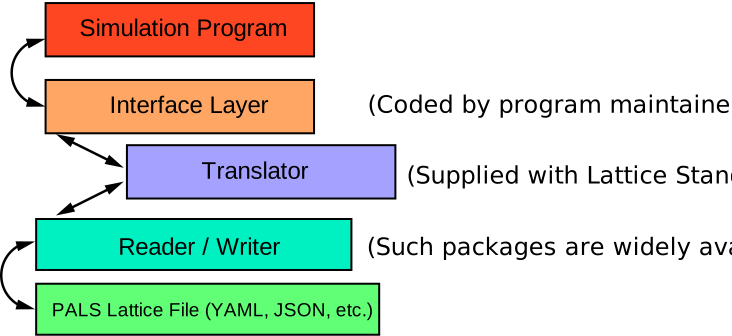
Fig. 1 Schematic showing how a simulation program can interact with a PALS file.#
The components here are:
Simulation program: A simulation program.
Interface layer: Code to interface between the structures defined by the program and the lattice structure defined by the Translator. This code will be program specific and outside the scope of the standard. However, structure translation should (hopefully) be relatively straightforward.
Translator: Package supplied with PALS. The Translator has code to put information into an “expanded form”. This includes expanding beam lines, evaluating expressions, etc.
Reader / Writer: Package to read/write files of a standard format (JSON, YAML, etc). Packages to do this are widely available.
PALS File: A file conforming to the PALS schema expressed in some standard format such as JSON, YAML, etc.
The PALS standard can be divided into several pieces:
Schema standard: The schema defines, in a language neutral manner, the information that can appear in a PALS file. This includes standardized names of lattice elements and lattice parameters, definitions of lattice parameters, how lattice elements can be organized into branches to describe the entire accelerator complex, etc.
File format standards: For various formats like YAML and Python there is a file format standard to ensure that different translators are able to read a PALS file.
Translator standard: After reading in a PALS file, a translator can present to a simulation program a data object that represents the PALS file. There are two basic representations that a PALS compliant translator must be able construct. The exact representation is a direct translation of the contents of the PALS file without any lattice expansions or expression evaluations. The expanded representation has, among other things, all lines expanded into branches and all expressions evaluated.
Note: Since the schema and translator parts are logically intertwined, there has been no attempt to separate these in the PALS documentation here. The file formats for the various languages like YAML, etc. are separately documented.