

Multipass#
By default, elements in a lattice are considered to be physically distinct from each other even if they have the same name. For example:
- this_line
    kind: BeamLine
    line:
      - EleA
      - EleA
In this example, the two EleA elements are considered to be physically distinct.
However, there are cases where sets of elements in a lattice represent the same physical element. Consider the Energy Recovery Linac (ERL) example shown in Fig. 15.
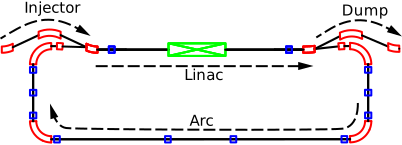
Fig. 15 Example Energy Recovery Linac (ERL): Particle beams are injected into the linac line from the injection line. After acceleration from the linac, the beams are transferred through the arc back to the linac where they are decelerated to recover their energy and then transfered to the dump line.#
In this example, a particle beam will:
1. travel through the injection line,
2. accelerate while traveling through the linac line,
3. travel through the arc line back to the linac line,
4. decelerate (energy recover) through the linac line,
5. get dumped into the dump line.
Beams on their journey travel through the linac twice and thus elements in the linac will show
up in the expanded lattice twice.
To mark pairs of elements in the lattice as the same physical element,
PALS has the multipass flag which can be applied to beam lines.
The ERL may then be constructed like:
- inj_line:
    kind: BeamLine
    line:
       ...

- dump_line:
    kind: BeamLine
    line:
      ...

- arc_line:
    kind: BeamLine
    line:
      ...

- linac_line:
    kind: BeamLine
    multipass: True
    line:
      - cavityA
      - cavityA

- erl_line:
    kind: BeamLine
    line:
      - inj_line
      - linac_line
      - arc_line
      - linac_line
      - dump_line

- erl:
    kind: Lattice
    branches:
      - erl_line
Here, for purposes of illustration, the linac_line has two elements both named cavityA.
Each of these elements is considered distinct from each other. However,
when the erl lattice is expanded, cavityA will appear four times:
inj_line..., cavityA, cavityA, arc_line..., cavityA, cavityA, dump_line...
             (1)      (2)                   (1)      (2)
Each physical cavityA element appears twice in the expanded line. Explicitly, the two cavityA
elements that are marked with a (1) underneath them represent the first of the cavityA
elements in linac_line and the two that are marked with a (2) underneath them represent second
cavityA element in linac_line.
In a more complicated situation where the linac_line is traversed \(N\) times,
the two physical cavityA elements will each appear \(N\) times in the expanded line.
Sets of lattice elements that represent the same physical element are called “physical element” sets.
The procedure for how to group lattice elements into physical element sets is as follows.
For any given element in the lattice, this element has some line it
came from. Call this line \(L_0\). The \(L_0\) line in turn may have been contained
in some other line \(L_1\), etc.
The chain of lines \(L_0\), \(L_1\), …, \(L_n\) ends at some point and the last (top) line
\(L_n\) will be one of the root lines used for a lattice branch.
For any given element in the lattice, starting with \(L_0\) and proceeding upwards through the
chain, let \(L_m\) be the first line in the chain that is marked as multipass. If no such
line exists for a given element, that element has no associated physical elements.
For elements that have an associated \(L_m\) multipass line,
all elements that have a common \(L_m\) line and have the same
element index[1] when \(L_m\) is expanded are taken to represent the same physical element.
In the example above, the chain for both cavityA physical elements is
linac_line, erl_line
and linac_line is the \(L_m\) line (first line in the chain that is marked as multipass) for both.
The elements of a physical element set do not have to all be in the same lattice branch. For example, in a colliding beam machine with two intersecting rings, the machine can be represented with two branches, one for each ring. The interaction region where both beams are passing through common elements can be a beam line that is marked multipass. In this case, physical element sets will all have two elements, one from each branch.
It is important to note that the floor coordinates of the elements in a physical
element set are not constrained by the multipass construction to be the same.
It is up to the lattice designer to make
sure that the floor positions of the elements in the set make sense (that is, are all the same).